Join our Industry Forum at GlobeCom 2025 - Advancing 5G/6G ORAN, MIMO and RIS Research, and Integrated Sensing and Communication (ISAC) Development
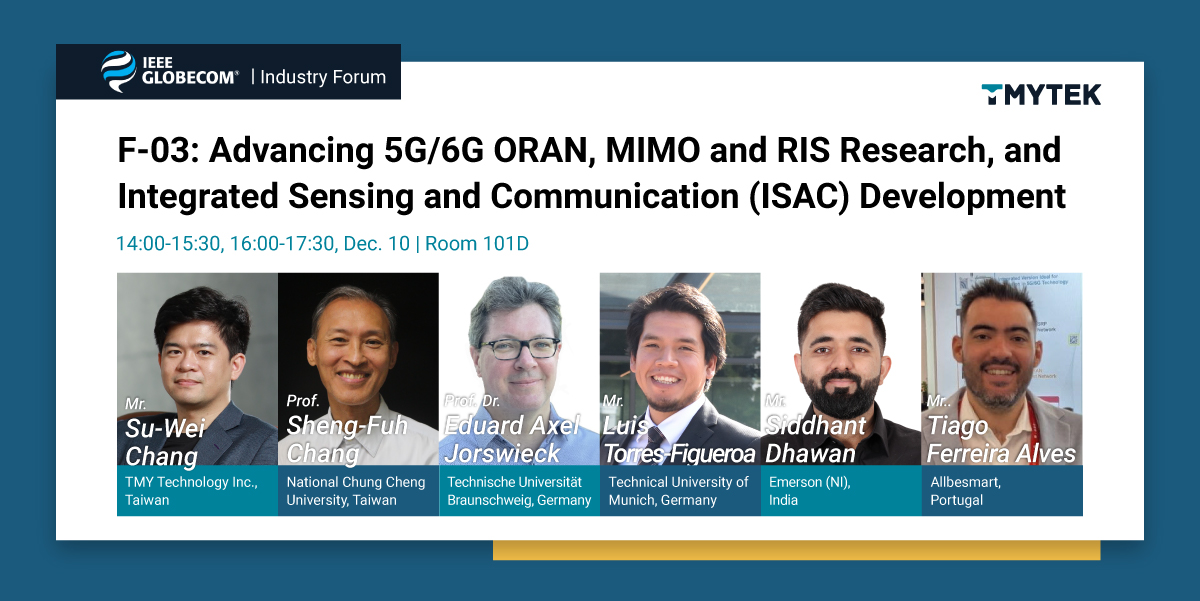
Date: December 10 (Wednesday)
Time: [ Part 1 ] 14:00 – 15:30 | [ Break ] 15:30 – 16:00 | [ Part 2 ] 16:00 – 17:30
Location: Room 101D
As the world moves toward the era of 6G, wireless communications are experiencing an unprecedented wave of innovation. The GlobeCom 2025 Industry Forum, organized by TMYTEK, places O-RAN, MIMO, Reconfigurable Intelligent Surface (RIS), and Integrated Sensing and Communication (ISAC) at the center of its agenda, guiding participants through the breakthrough technologies and future roadmap of next-generation networks. Bringing together leading experts from Taiwan, India, Germany, and Portugal, this forum highlights the most influential advances—from millimeter-wave and 5G/6G testbeds, intelligent reconfigurable surfaces, and AI-driven 6G systems to open-source OAI platforms and next-generation network architectures.
Curious about how 6G will integrate sensing, intelligent control, and open network design? Interested in understanding the role of RIS, O-RAN, and AI/ML in future base stations and wireless systems? Through real prototypes, experimental demonstrations, and practical deployment insights, this forum provides a comprehensive perspective on the future of wireless communications. Whether you are a researcher, engineer, student, or technology leader, this is the must-attend platform for staying ahead in 5G and 6G innovation.
Session Highlight
Session 1: Revolutionizing RF for 6G: Testbeds, Architectures, and Spectrum Frontiers
Speaker: Mr. Su-Wei Chang, TMY Technology Inc, Taiwan
Time: 14:00 – 14:30
Abstract
As 5G scales globally and 6G research advances, the integration of O-RAN, MIMO, Reconfigurable Intelligent Surface (RIS), and Integrated Sensing and Communication (ISAC) is becoming central to next-generation wireless systems. However, realizing these technologies at scale requires testable platforms, flexible RF front-ends, and open-source ecosystems. This forum highlights how researchers and engineers can use mmWave testbeds and OAI-based frameworks to accelerate prototyping, validate new concepts, and ensure real-world deployability in 6G environments.
Session 2: Integrated Design of Intelligent Reconfigurable Surfaces: Control, Deployment, and Applications
Speaker: Prof. Sheng-Fuh Chang, National Chung Cheng University, Taiwan
Time: 14:30 – 15:00
Abstract
Reconfigurable Intelligent Surface (RIS) technology has emerged as a key enabler for next-generation wireless communications, capable of intelligently shaping the electromagnetic environment with low power consumption (<100 W). This talk presents a series of integrated RIS-related topics, covering control architectures, deployment experiences, and application demonstrations. At the hardware design level, the discussion involves operating RIS in FR1, FR2, and even FR3 frequency bands, as well as meeting the design requirements of multi-bit, polarization, and STAR-type RIS units. Algorithm-assisted phase optimization is also introduced to achieve fast and stable reflection control. At the system level, both static and dynamic RIS prototypes are analyzed through real-world deployment and measurement, supported by ray-tracing simulations and electromagnetic heat-map validation. Furthermore, this study demonstrates the potential of RIS in Integrated Sensing and Communication (ISAC) and O-RAN systems, highlighting its role as an intelligent and indispensable network component for future 6G communications.
Session 3: RIS assisted communications: from models to optimization
Speaker: Prof. Dr. Eduard Axel Jorswieck, Technische Universität Braunschweig, Germany
Time: 15:00 – 15:30
Abstract
Reconfigurable intelligent surfaces (RIS) can assist wireless communication systems to achieve high reliability and availability, improved coverage, and intrinsic security. In the short talk, we will review recent scattering and signal models for classical diagonal, beyond-diagonal, general passive, and active RIS. The optimization of the RIS elements by classical and machine learning algorithms is briefly touched and both numerical and experimental results are reported.
☕ Coffee Break: 15:30 – 16:00
Session 4: Practical Aspects of Semantic Secure Communications, Post-Shannon Theory and Waveform Design beyond 5G
Speaker: Mr. Luis Torres-Figueroa, Technical University of Munich, Germany
Time: 16:00 – 16:30
Abstract
6G envisions a seamless integration of machine and human interactions, with the number of simultaneous communication links increasing manifold. In addition, such a ubiquitous communication setting needs to cope with new hazards posed by the advent of a quantum era. Recent advances in information theory have shown promising results in two fundamental aspects: the post-Shannon theory of identification has the potential of considerably reducing the spectrum needed in semantic communications scenarios, and explicit constructions of semantic secure codes provide quantum-secure guarantees at the physical layer with a negligible latency overhead (in addition to PQC). Combined with a new waveform design for precise Doppler and delay estimation in fast-fading multi-path channels, both terrestrial and non-terrestrial communications may benefit from such innovative approaches. This presentation highlights the practical aspects of these theoretical promises by discussing the experimental results when implementing and integrating them into software-defined radios for the transmission of 5G NR and other waveforms beyond 5G.
Session 5: USRP introduction and 6G overview
Speaker: Mr. Siddhant Dhawan, Emerson (NI), India
Time: 16:30 – 17:00
Abstract
This tutorial presents a comprehensive overview of our portfolio of Universal Software Radio Peripheral (USRP)-based platforms, emphasizing their role in enabling advanced 5G and emerging 6G research. With the evolution toward 6G, driven by the latest updates from 3GPP and global research initiatives, there is a growing need for open, flexible, and intelligent prototyping environments. We showcase a series of real-time 6G demonstrations including Integrated Sensing and Communication (ISAC), OpenAirInterface (OAI)-based systems, Neural Receivers, and AI-driven spectrum sensing. Central to this tutorial is the implementation and operational workflow of a real-time AI/ML-based Neural Receiver built on the OAI software stack and USRP software-defined radio (SDR) hardware. This open-source system provides a modular and extensible architecture for prototyping and experimentation, facilitating the development, testing, and demonstration of AI/ML-enhanced 5G/6G capabilities. The platform supports a wide range of research scenarios, enabling rapid innovation in wireless communication technologies.
Session 6: OAIBOX: 5G/6G open source made simple
Speaker: Mr. Tiago Ferreira Alves, Allbesmart, Portugal
Time: 17:00 – 17:30
Abstract
OpenAirInterface™ (OAI) is an open-source software platform that brings together a global community of developers. It is the leading open-source project providing a complete reference implementation of the 5G Core Network, 5G Base Station (gNB), and User Equipment (UE). Developed by Allbesmart, the OAIBOX™ is an abstraction layer that simplifies the deployment and use of OAI.
In this workshop, participants will take part in a 5G Operational Walkthrough using OAIBOX™ and OpenAirInterface™. They will learn how to set up 5G test networks, explore the 3GPP 5G NR protocol stack, configure the air interface, and perform network monitoring using the OAIBOX™ dashboard and Wireshark. The session will also demonstrate how to extend the OAI codebase.
Several 5G/6G research use cases will be showcased, including xApps for network slicing, spectrum sharing, FR2, FR3, RIS, and Integrated Sensing and Communication (ISAC) applications. Participants will learn how to accelerate end-to-end 5G/6G experimentation using the open-source OpenAirInterface™ (OAI) stack.
>> Reserve the meeting with sales representatives at sales@tmytek.com