Integrated Sensing and Communication (ISAC) Physiological Signal Detection System Based on mmWave Array of Phased Arrays (APA)
 The integration of TMYTEK’s mmW-SDR platform provides a flexible and practical framework for validating advanced multi-beam mmWave sensing and communication systems. In our SideSense research on physiological motion detection, the platform enables rapid prototyping and reliable real-time experimentation, significantly accelerating the evaluation of integrated sensing and communication concepts.
Executive Summary
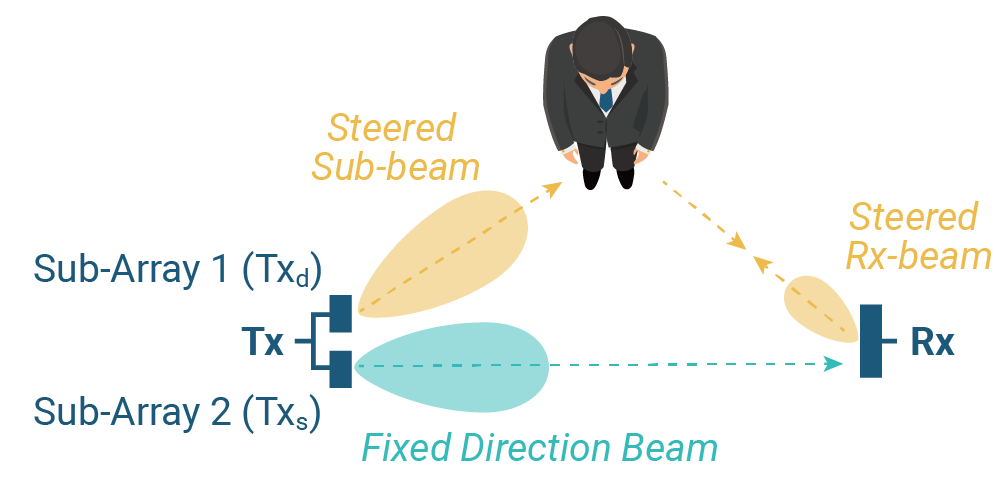
With the development of 5G and 6G technologies, Integrated Sensing and Communication (ISAC) has become a key trend. However, a fundamental challenge remains: communication and sensing require inherently different beam control strategies, communication relies on stable directional beams, while sensing requires adaptive spatial exploration to capture weak reflections. Traditional systems address this mismatch through time-switching or performance trade-offs. Meanwhile, advances in mmWave antenna arrays enable more flexible and complex beam patterns (e.g., multi-beam and sub-beam), creating new opportunities for joint operation.
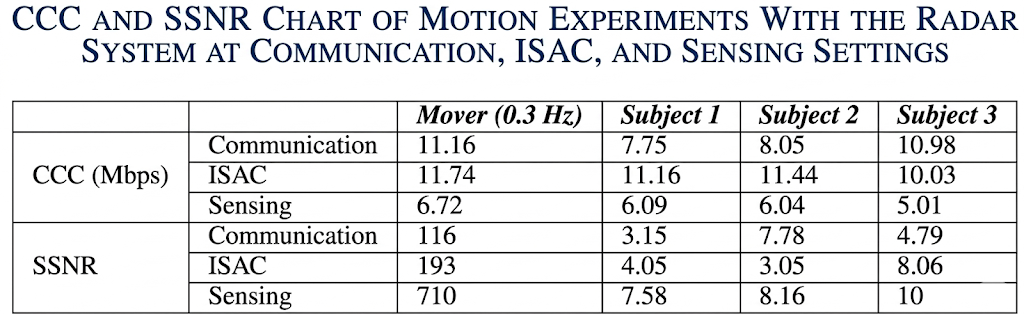
This use case presents SideSense, a system architecture based on an Array of Phased Arrays (APA) using TMYTEK mmWave platforms to realize a low-cost and efficient dual-function system. By leveraging sub-beams and side-lobes for sensing while maintaining a dedicated communication beam, the system enables simultaneous operation without interruption. Experimental results show an 84% improvement in sensing signal-to-noise ratio (SSNR) while preserving a stable communication link.
Challenges
- Limitation of Single-Beam Architectures: Traditional mmWave systems rely on a single main beam optimized for communication, making it difficult to simultaneously support sensing, which requires dynamic beam control. This beam mismatch often leads to time-switching or degraded performance.
- Underutilization of Advanced Antenna Arrays: Although modern phased arrays can generate more complex beam patterns (e.g., multi-beam and sub-beam), effectively exploiting these capabilities for ISAC remains a key challenge.
- High Hardware Cost: Achieving true multi-beam operation typically requires expensive fully digital radar architectures, limiting scalability.
- Weak Physiological Signal Detection: Millimeter-scale physiological signals, such as respiration, are easily masked by noise in practical environments, making reliable sensing difficult without disrupting communication.
The TMYTEK Solution
This case adopts the TMYTEK BBox and UD Box series products to construct an experimental platform equipped with APA (Array of Phased Arrays) capabilities. The greatest advantages of this architecture lie in its "simple configuration" and "flexible control".
Core Hardware Configuration
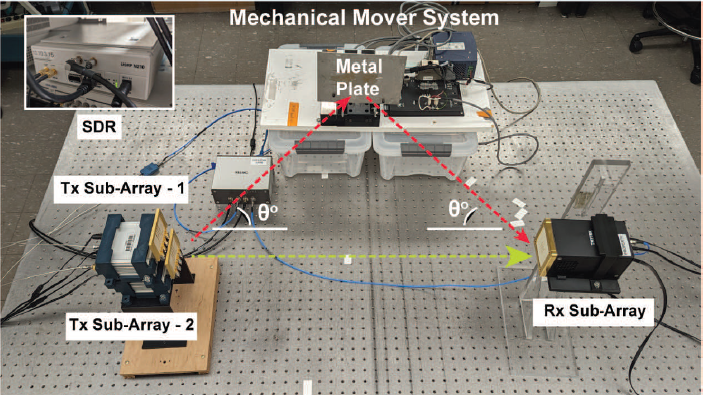 The system adopts a Dual-TX / Single-RX architecture:
- Frequency Conversion Core:
- TMYTEK UD Box (Up/Down Converter) It is responsible for up-converting the 3.5 GHz intermediate frequency (IF) signal from the backend SDR (USRP N210) to 28 GHz mmWave, and down-converting the received signal to send it back. It serves as the bridge connecting the digital world to the mmWave world
- Beamforming Transmitter (TX):TMYTEK BBox Lite (x2)
- Utilizes two stacked BBox Lites connected to the same RF signal source.
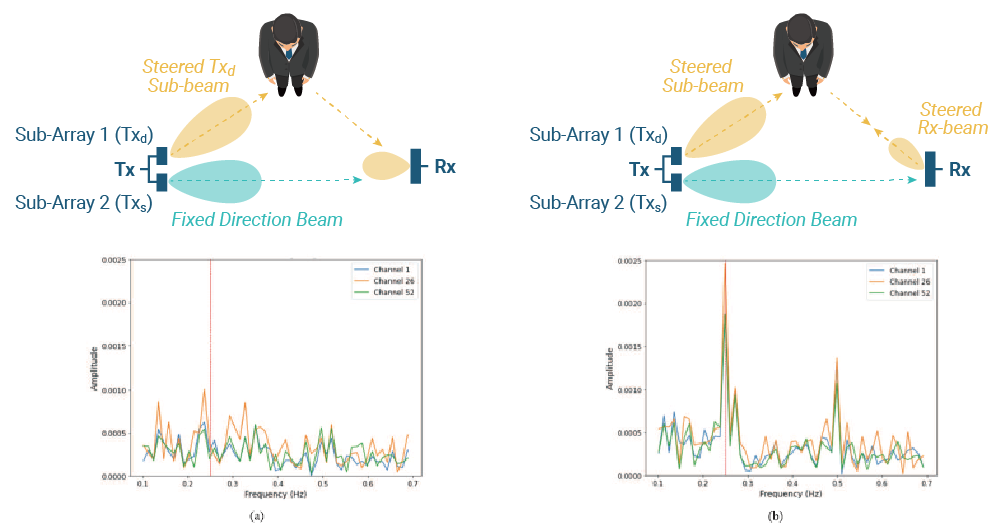
- Sub-Array 1 (Sensing Beam TXd): Responsible for dynamic scanning to find and lock onto the human target.
- Sub-Array 2 (Communication Beam TXs): Responsible for continuously pointing at the receiver to maintain the communication connection.
- Beamforming Receiver (RX):TMYTEK BBox One (x1)
- Responsible for receiving the combined signal from the communication path (direct line-of-sight) and the sensing path (reflection).
Architecture Advantages
Through TMYTEK's modular design, users do not need to purchase expensive dedicated radar equipment; by simply adding a set of BBox to the existing communication architecture, it can be upgraded to a JCS system.
Core Technological Advantages: Precise Beam Empowerment by TMYTEK BBox
This case uses the TMYTEK BBox Lite (TX) and BBox One (RX) as the mmWave front-end, whose unique features provide the SideSense system with the following key advantages:
1.High-Resolution Spatial Scanning: Supports fine beam steering of ±45° (in 5° increments), allowing the system to execute "Beam Switch" in the algorithm to precisely lock onto the human body's position without interfering with the main communication link.
2. Dynamic Gain Optimization: Through the amplifier control of the BBox, the system can dynamically adjust the energy ratio of the two beams. Experiments have confirmed that when the BBox tunes the intensities of the sensing beam and the communication beam to a balance (Gain Ratio ≈ 1), it maximizes the dynamic range of the respiration signal.
3. Flexible APA Architecture: The lightweight design of the BBox allows for easy stacking to construct an APA (Array of Phased Arrays) system. Only a single set of UD Box frequency converter is needed to drive multiple BBox units for multi-beam operation, significantly lowering the development threshold and hardware costs for 6G JCS technology.
Visit [mmW-SDR Product Page] to learn more about TMYTEK's advanced SDR solutions.
Methodology & Simplified Algorithm
SideSense does not rely on complex mathematical formulas; instead, it uses a physical-layer beam control strategy to detect respiration by utilizing the Amplitude variations of the CSI (Channel State Information)
The 3-Step Tuning Protocol
To capture minute respiratory signals in an "asynchronous" environment, the system executes the following simple logic:
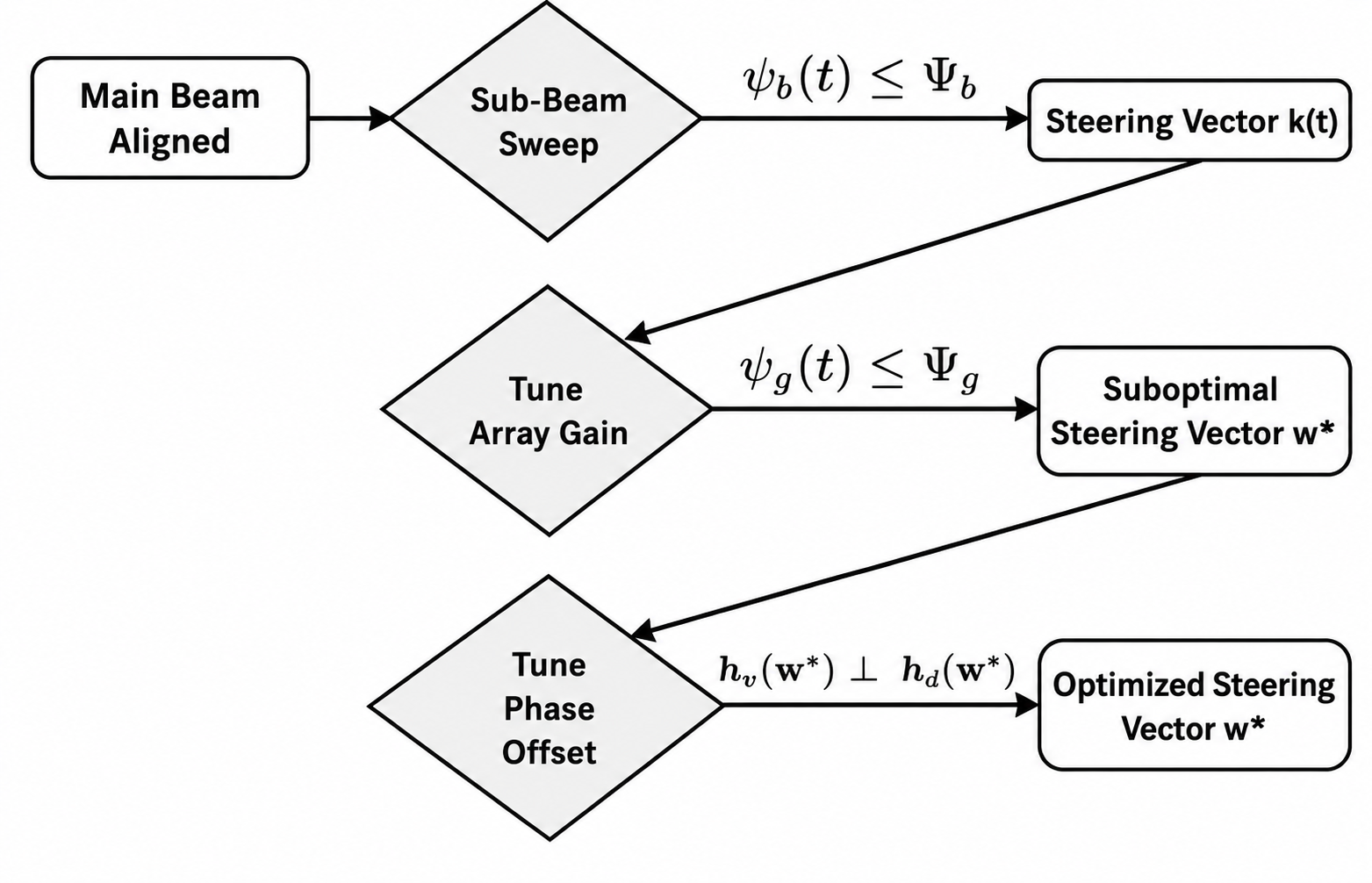
- 1. Beam Switch — "Finding the Target"
- Keep the communication beam (TXs) fixed.
- Control the sensing beam (TXd) to scan and find the angle with the largest variation in the reflected signal, locking onto the human body's position.
- 2. Gain Tuning — "Adjusting the Balance"
- Use the BBox's gain control function to adjust the transmission power of the sensing beam.
- Target: Make the "human body reflected signal strength" and the "direct communication signal strength" close to 1:1.
- Principle: When the intensities of the two signals are comparable and interference occurs, tiny respiratory vibrations will cause the most drastic changes in the amplitude of the combined signal (maximizing sensitivity).
- 3. Detection
- Collect the tuned CSI amplitude data.
- Through FFT (Fast Fourier Transform) analysis, a respiration frequency peak of 0.2 ~ 0.33 Hz (corresponding to 12-20 breaths per minute) can be clearly seen on the spectrum.
Experimental Results
The experiment utilized a mechanical moving platform (Mechanical Mover) to simulate chest fluctuations and conducted real human breathing tests.
- Experimental Setup: Two TX BBox Lites were stacked, with one aimed at the receiver (at a distance of 1.08m) and the other aimed at a metal plate or the test subject on the side.
- Key Results:
- 1. High Sensitivity: Compared to traditional single-beam systems, the SideSense architecture improved the Sensing Signal-to-Noise Ratio (SSNR) by 84%.
- 2. Uninterrupted Communication: Although diverting energy to the sensing beam caused the Communication Capacity (CCC) to drop by 35%, this is still within the acceptable range for 5G networks, and no link failure occurred.
- 3. Successful Detection: On the IQ constellation diagram, it can be clearly seen that the signal trajectory under JCS mode forms a distinct arc, successfully recovering the respiration waveform.
Conclusion
This use case successfully demonstrated the application value of TMYTEK mmWave products in 6G (JCS/ISAC) research.
Through the SideSense system built with TMYTEK BBox and UD Box, researchers can:
- Realize APA architecture at a low cost: Conduct multi-beam experiments without the need for a Full Digital radar.
- Flexibly verify algorithms: Easily control beam angles and gain to verify the optimal balance point between "communication" and "sensing".
- Apply to smart healthcare: Confirm that high-precision non-contact health monitoring can be performed simultaneously without interrupting network services.
This proves that TMYTEK's solution is an ideal platform for developing next-generation wireless communication applications.
Explore TMYTEK mmW-SDR Solutions ➔
Reference: Based on the IEEE paper "SideSense: Robust Physiological Motion Detection via mmWave Joint Communication and Sensing Systems With Multiple Beams".